
The single highest-impact move is a structured feedback loop: a seven-question form sent at the right moment, in-meeting capture for creative work, and routed follow-up that lands on a specific person's desk within 24 hours. Assign one owner to close every loop. Do this before you build dashboards or buy new software, because unrouted feedback sitting in a spreadsheet prevents nothing and fixes nothing.
TL;DR:
- Routing client feedback responses with clear, automatic escalation rules ensures issues are addressed within 24 to 48 hours, preventing unresolved frustrations.
- Combining structured surveys with in-review annotations and passive analytics provides a comprehensive view of client satisfaction and early warning signs.
- Personalized survey invitations sent from the account manager’s email during mid-week mornings significantly boost response rates to 60-80 percent.
- Using pixel-anchored comments and guest-reviewer access reduces ambiguity and friction, enabling faster, more precise creative feedback workflows.
- Incorporating recurring, co-created sensemaking surveys for high-severity issues improves trust and reduces anger in service recovery over isolated, one-time check-ins.
Table of Contents
- What Are the Best Ways to Collect Agency Client Feedback?
- A Ready-to-Use Client Feedback Template You Can Copy Today
- How Should You Route and Escalate Client Feedback?
- Which Tools Help You Organize and Track Client Feedback?
- Does Client Co-Creation Actually Improve Service Recovery?
- How Do You Turn Feedback Into Prioritized Action?
- How to Design a Feedback Program Without Causing Survey Fatigue
- What's the Right Way to Handle Negative Client Feedback?
- What I've Learned Reviewing Thousands of Client Feedback Threads
- Put This Playbook to Work With Pinhub
- Sources
- FAQ
What Are the Best Ways to Collect Agency Client Feedback?
Different moments call for different collection methods, and using the wrong one for the situation is why so much client input gets lost or ignored. A rushed email survey after a tense kickoff call gets you noise. A quiet, well-timed prompt after a milestone gets you signal.
Structured surveys work best at predictable checkpoints: after a milestone delivery, thirty days post-launch, and then quarterly or twice a year for ongoing retainers. Sending a survey mid-crisis or right after a missed deadline skews results toward frustration, rather than a fair read of the relationship.
In-review capture matters most for creative and design work, where vague comments like "make it pop more" waste hours of guesswork. Annotated screenshots or pixel-anchored comments tied to an exact spot on a design eliminate that ambiguity, because the client points at the thing instead of describing it.
Interviews and support tickets give you qualitative texture that a five-point scale never will. A quarterly quality-business-review call surfaces concerns a client wouldn't type into a form. Support tickets, meanwhile, are a passive feedback channel agencies routinely ignore. Every complaint logged there is a data point.
Passive analytics round out the picture: portal login frequency, email response times, meeting attendance. A client who used to reply in an hour and now takes three days is telling you something before they ever fill out a survey.
Operational details determine whether any of this actually gets responses:
- Send surveys from the account manager's personal email, not a generic "feedback@" address; personalized sends produce response rates of 60 to 80 percent versus 15 to 25 percent for generic blasts.
- Time the ask for Tuesday through Thursday mornings, avoiding Mondays and the days right before a deadline.
- Reference the specific project or deliverable by name in the subject line instead of "Quick survey."
- Keep the form under two minutes to complete, and say so upfront.
A Ready-to-Use Client Feedback Template You Can Copy Today
A seven-question client feedback form captures the signals that matter most while staying short enough that clients actually finish it. Here's the core structure:
- Overall satisfaction with our work this period (1 to 5 scale)
- How would you rate our communication? (1 to 5 scale)
- How satisfied are you with deliverable quality? (1 to 5 scale)
- Did we meet agreed timelines? (1 to 5 scale)
- How likely are you to recommend us to a colleague? (0 to 10, the standard NPS question)
- Are you interested in expanding scope or adding services? (Yes / No / Maybe)
- Anything else you'd like to share? Plus a checkbox for testimonial consent.
That combination of satisfaction, timeline, NPS, and expansion interest gives you both a health check and a pipeline signal in one send. It's also short enough that clients rarely abandon it halfway through.
For faster cadences, trim it down. A three-question milestone pulse (satisfaction, one open comment, and an NPS question) works well right after a deliverable ships, when you want a quick temperature check without asking for a full form.
For recovery situations after a service failure, swap in a sensemaking survey: a short, repeated check-in over several weeks that asks the client to reflect on both how they think about what happened and how they feel about it now. More on why that repetition matters in a moment.
Pro Tip: Prefill the client's name, project name, and account manager into the survey before sending it. Personalized forms consistently outperform generic ones, and the ten seconds it takes you to prefill a field saves the client from wondering if this is a mass blast.
Link to a fuller library of client feedback questions if you want more variants by project type.
How Should You Route and Escalate Client Feedback?
A score without a workflow attached is just a number nobody acts on. Routing rules turn raw responses into next steps automatically, and they should be built into the form itself using conditional logic.

Detractor routing: any NPS score of 0 to 6, or a deliverable-quality score of 2 or lower, should trigger an alert to agency leadership within 24 hours. That's not a suggestion, it's an SLA. The follow-up script is simple: acknowledge the specific issue named, ask one clarifying question, and propose a concrete next step within the same conversation. Waiting a week to respond to a detractor is functionally the same as not responding at all.
Promoter routing: a score of 9 or 10 combined with a "Yes" or "Maybe" on expansion interest should route to a referral or testimonial request within 48 hours, while the goodwill is fresh. Most agencies let these moments evaporate because nobody owns the follow-up.
- Detractor (NPS 0 to 6 or quality ≤2): leadership outreach within 24 hours, documented resolution plan.
- Neutral (NPS 7 to 8): account manager check-in within one week.
- Promoter (NPS 9 to 10 + expansion interest): referral or testimonial ask within 48 hours.
Ownership is the piece most agencies skip. Assign a named feedback owner, tag every response with a ticket ID, and require evidence of closure, not just an internal note that says "handled."
Pro Tip: Treat every detractor response like a support ticket with an SLA clock, not an email you'll get to eventually. The 24-hour window matters more than the script you use inside it.
Which Tools Help You Organize and Track Client Feedback?
Four tool categories cover most of what an agency needs, and most teams are missing at least one of them.
- Forms and NPS tools handle the structured survey layer: your seven-question form, pulse checks, and scheduled sends.
- Visual annotation and review platforms handle creative and design feedback, where comments need to attach to an exact point on an image rather than live in a separate email thread.
- CRM and ticket integrations connect feedback responses to the account record, so a detractor score shows up next to the client's history instead of sitting in a survey tool nobody checks.
- Dashboards and synthesis tools roll individual responses into trends over time.
The second category deserves more attention than it usually gets. Pixel-anchored visual comments, where a reviewer pins a note to an exact spot on a screenshot or Figma file, remove the single biggest source of ambiguity in creative review: the client saying "the header looks off" and the designer guessing which part. Guest-reviewer access, meaning a client can leave feedback without creating an account, removes the second biggest source of friction: the client who has feedback but never gets around to logging in to share it.
A working implementation checklist: integrate form responses directly into your ticketing system so a low score auto-creates a task, tag every piece of feedback by project and client, and build a monthly synthesis pass that pulls recurring themes out of open-comment fields. For teams handling website and design projects specifically, a dedicated guide to web design feedback and a rundown of design feedback tools both cover setup patterns worth borrowing.
Does Client Co-Creation Actually Improve Service Recovery?
Yes, and the mechanism is worth understanding before you write your next apology email. When agencies unilaterally decide how to fix a mistake, clients tend to interpret the response as self-serving, even when the fix is reasonable. When clients participate in designing the recovery plan, that interpretation shifts. Research on customer participation in co-created service recovery found that involving the affected party in shaping the remedy reduces this bias and increases satisfaction with the outcome, independent of what the remedy actually costs.
The second finding matters just as much for how you structure follow-up. Four longitudinal studies on sensemaking surveys and customer revenge found that repeated surveys administered over several weeks reduced anger, betrayal, and revenge-related responses far more than a single survey sent right after the failure. A one-time "how did we do fixing that?" email doesn't give clients time to process; a short series does, and it can even build trusting belief in the relationship rather than just neutralizing anger.
The practical translation: reserve sensemaking surveys for higher-severity failures, not routine hiccups, and pair them with a co-creation conversation rather than sending a survey in place of one.
How Do You Turn Feedback Into Prioritized Action?
Feedback that never becomes a decision is a wasted collection cycle. Five metrics deserve a permanent spot on your dashboard: NPS trend over time, relationship health (sometimes tracked as a TRR score), response rate per survey wave, detractor salvage rate (how many detractors you converted to neutral or promoter after intervention), and expansion conversion from feedback-flagged opportunities.
Relationship health deserves more weight than most agencies give it. Benchmark research from VerityRI found that how the relationship feels to a client predicts retention and upsell success even more reliably than delivery quality alone, which is why tracking a relational metric alongside NPS catches risk that satisfaction scores miss.
When a theme repeats across three or more clients, treat it as a root cause worth a real fix rather than three isolated complaints:
- Pull open-comment responses into a monthly synthesis and tag by category (communication, timeline, quality, scope).
- Convert any theme appearing in 3+ responses into a scoped experiment with an owner and a deadline.
- Report NPS trend and relationship health to leadership monthly; report full synthesis quarterly.
- Feed recurring scope complaints directly into how you price and staff the next contract renewal.
How to Design a Feedback Program Without Causing Survey Fatigue
Cadence discipline prevents the single most common failure mode: clients who stop responding because you asked too often, or a relationship that quietly deteriorates because you never asked at all. Milestone pulses after each major deliverable, paired with a full quarterly or biannual survey for retainer clients, covers most situations without overloading anyone's inbox.
Build a governance layer around that cadence:
- Name one feedback owner per account who is accountable for closing every loop, not just collecting responses.
- Define an escalation path in writing before you need it, not after a detractor response arrives.
- Hold a quarterly feedback review where leadership looks at trends, not just individual scores.
- Revisit your question bank and routing rules annually; a form that made sense two years ago may be missing your current service lines.
Three pitfalls sink most programs. Sending from a generic address instead of the account manager's own email tanks response rates. Skipping detractor routing means low scores sit unread until the client churns. And treating a single feedback score as your only churn predictor ignores everything the relationship health data and support ticket volume are already telling you.
What's the Right Way to Handle Negative Client Feedback?
A detractor score is an opportunity with a short shelf life, and how you respond in the first 24 hours shapes whether it becomes a fixed relationship or a lost account.
- Acknowledge within 24 hours. A same-day response, even a brief one, signals the concern was heard before you have a full solution ready.
- Co-create the recovery plan. Bring the client into the conversation about what "fixed" looks like rather than presenting a solution and hoping it lands; this reduces the self-serving bias clients often read into unilateral fixes.
- Match the remedy to severity. Research on service recovery and compensation expectations shows that when the agency is clearly at fault for an outcome failure, clients expect substantive remediation, not just an apology; a process fix suits a minor miss, while a significant outcome failure may call for service credits or a partial refund.
- Document the agreed actions in writing so both sides have the same record of what was promised.
- Follow up with a short sensemaking survey across the following weeks, rather than a single check-in, to confirm the fix actually rebuilt trust.
What I've Learned Reviewing Thousands of Client Feedback Threads
The gap between agencies that collect feedback and agencies that act on it usually comes down to one thing: ambiguity. A client writes "this doesn't feel right" about a design, and three people interpret it three different ways before anyone asks what "this" even means.
Pixel-anchored comments close that gap because the client points at the exact pixel instead of describing it in prose. Guest-reviewer access closes a second gap: the client with feedback who never logs in to share it. Version history and automated summary lists mean an account manager can scan what changed and what's still open in minutes instead of re-reading a week of email threads. None of that replaces a good routing workflow. It just removes the friction that keeps feedback from reaching the person who can act on it.
— Pinhub
Put This Playbook to Work With Pinhub
Every workflow in this article, from pixel-anchored comments to guest-reviewer access to routing feedback by severity, is what Pinhub was built to run. Instead of managing annotated screenshots in one tool, form responses in another, and version history nowhere at all, you get pixel-level comments anchored to exact spots on a design, unlimited guest reviewers who never need to create an account, and AI-generated summaries that turn a week of scattered feedback into a short list an account manager can act on the same day.
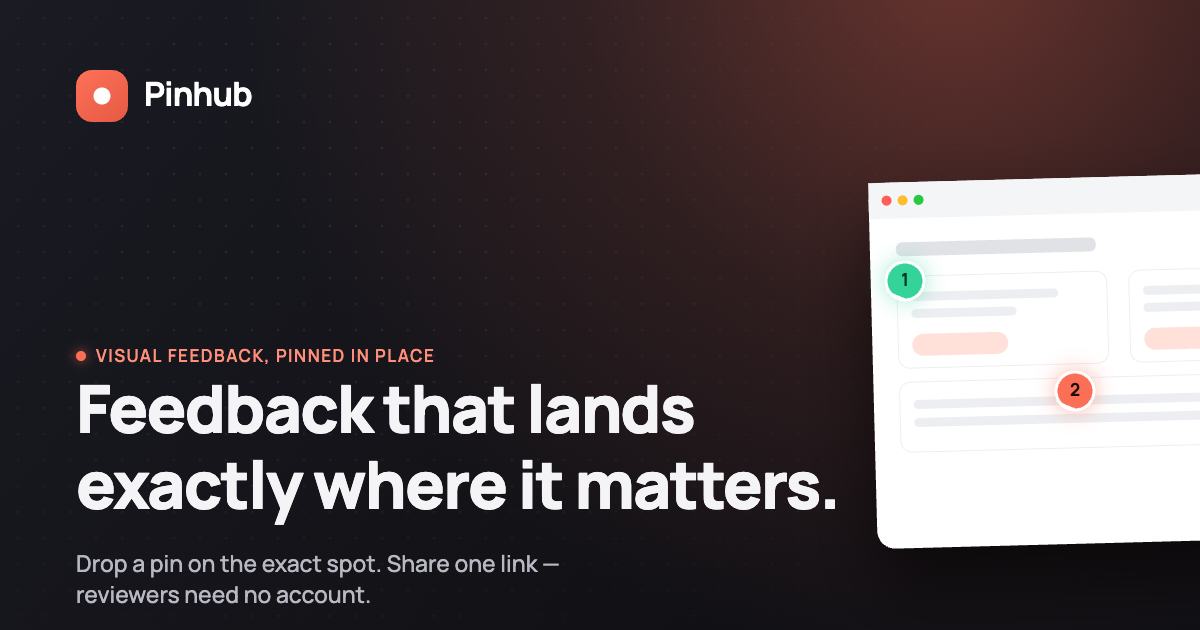
If you're building your first structured feedback loop, start with the free plan and map one project's review cycle to it before rolling it out agency-wide. When you're ready for team-wide version control, password-protected shares, and Figma import, the Pro plan runs $19 per month or $180 per year, and the Team plan runs $39 per month or $384 per year. Visit the Pinhub product page to see which plan fits your current review volume, or browse the Pinhub blog for more workflow breakdowns like the ones covered here. Automating the busywork around feedback synthesis also frees up account manager time, a pattern echoed in broader research on AI-driven productivity gains for agencies.
Sources
- Free Client Feedback Form Template for Agencies (2026) | Antforms Blog
- The effects of customer participation in co-created service recovery. (journal entry DOI placeholder)
- Service recovery and compensation expectations (Springer article)
- The Relationship Report 2025 (VerityRI)
FAQ
Can You Give Examples of Good Client Feedback?
Good feedback is specific and tied to a location or moment, not a general reaction. "The homepage headline in the second section doesn't match our brand voice" is actionable; "I don't love the homepage" isn't. Pixel-anchored comments naturally produce the specific kind because the client is pointing at something exact.
What Do Strong Positive Reviews Usually Include?
The strongest positive reviews name a specific outcome, a specific person, and a specific timeframe, such as praising quick turnaround on a rush request or clear communication during a tight deadline. Generic five-star comments like "great team, would recommend" carry far less weight in a testimonial than one citing a concrete result.
How Often Should Agencies Collect Client Feedback?
Milestone pulses after each major deliverable, paired with a quarterly or biannual full survey for retainer accounts, cover most agency relationships without causing fatigue. Project-based work should add a survey some weeks after launch, when the client has had time to actually use the deliverable.
What Should You Do About Low Survey Response Rates?
Response rates jump sharply when surveys come from the account manager's personal email instead of a generic address, rising to 60 to 80 percent from 15 to 25 percent in practitioner data. Keep the form under two minutes, name the specific project in the subject line, and send it Tuesday through Thursday morning rather than Monday or right before a deadline.
Does Pinhub Help With Collecting Agency Client Feedback?
Pinhub supports the visual side of feedback collection directly, letting clients pin comments to exact points on a screenshot or Figma design without creating an account. Paired with a structured survey and clear routing rules, it closes the ambiguity gap that makes creative feedback slow to act on.