
Design version control means tracking, naming, and organizing changes to design files so teams always know which version is current, what changed, and why. For most design teams, the right default is lightweight topic branching combined with explicit published versions and short commit messages. The exception is CAD and other non-mergeable binaries, where locking or a dedicated PDM system works better than a Git-style workflow.
TL;DR:
- Version control practices should include creating short-lived branches for each task and publishing locked versions before handoff to reduce errors.
- CAD and binary files require locking or dedicated PDM systems to prevent assembly breakage and reference issues during reorganizations.
- Combining Git workflows with native design tool versioning and centralized PDM systems offers flexible strategies tailored to different file types and team needs.
- Clear habits such as small commits, defined ownership of merges, and consistent changelog patterns are essential to maintain a clean version history.
- Using pixel-anchored comments linked to specific versions streamlines feedback and approvals in design review processes.
Table of Contents
- What design version control actually solves
- Why version control actually pays off for design teams
- Core methods: Git-based, design-tool native, and centralized systems
- Daily workflow rules that keep versions clean
- Handling binary and CAD files without breaking assemblies
- A rollout checklist that won't stall your team
- Where feedback and versioning actually meet
- Put version control and feedback in one workspace
- Where to go deeper on setup and workflow design
- Sources
- FAQ
What design version control actually solves
Design version control applies to anything a team iterates on: artboards, PSD and AI files, Figma components, design tokens, and prototypes. Without a system, teams run into the same problems repeatedly.
- Duplicate files pile up with names like "final," "final_v2," and "final_final."
- Real history disappears, so nobody can say why a change was made or who approved it.
- CAD assemblies break when a referenced part gets renamed or moved.
A shared vocabulary helps here. A commit is a recorded change. A branch is an isolated space to try something without disturbing the main file. A lock prevents two people from editing the same binary at once. A publish marks a version as ready for others to use. A changelog lists what changed, in order, so anyone can catch up fast.
Why version control actually pays off for design teams
The benefit shows up first at handoff. When engineering pulls a published, locked version instead of "whatever's in the shared folder," fewer bugs come from mismatched assets or missing states.
Version history also gives you an audit trail. If a stakeholder asks why a button color changed in October, you can point to the exact version and the commit message that explains it, and roll back cleanly if the change turns out to be wrong.
- Branches let designers test riskier ideas without threatening the file everyone else depends on.
- A short commit message habit turns review cycles into conversations about specific changes instead of guesswork.
- Locked, published versions cut down on the back-and-forth caused by someone editing a file mid-review.
**Design review tooling that anchors comments to pixels and specific version snapshots reduces ambiguous feedback, since it's immediately clear which change a comment refers to. That clarity compounds: fewer rounds of "which version are you looking at?" means faster approvals and less rework overall.
Core methods: Git-based, design-tool native, and centralized systems
Three approaches dominate in practice, and most teams end up using more than one.
Git-based workflows work well for design tokens, code-adjacent assets, and any file type that benefits from branching and merging. Teams use short-lived topic branches for individual tasks, merging back often to keep history readable and reduce the mental overhead of long-lived branches. For large binaries inside a Git repository, Git LFS replaces the file with a lightweight pointer so the repository doesn't balloon in size.
Design-tool native versioning, the kind built into tools like Figma, offers a complementary model. It gives visual teams branching and merging without asking them to learn Git, which fits art and UI teams whose files don't map cleanly onto code-style diffs. Our Figma versioning guide walks through setting this up step by step.
Centralized, lockable systems, including PDM tools and Perforce, exist because CAD and other engineering-heavy binaries can't be merged or diffed at all. Trade-offs across all three: Git scales well but adds complexity for non-technical teams, design-tool versioning is easy to adopt but tied to one tool, and PDM systems solve reference integrity at the cost of licensing fees and a steeper learning curve.

Daily workflow rules that keep versions clean
Most version control failures aren't tooling problems, they're habit problems. These rules work regardless of which system you choose.
- Create a topic branch for each task, not each person, and merge it back as soon as the task is done.
- Keep commits small and specific, one logical change per commit, so history stays readable.
- Publish a locked "ready for development" version before handoff, and require a one-line commit message plus a short "why" note.
- Lock binaries that can't be merged, and name an explicit owner for resolving conflicts when they arise.
- Use a consistent changelog pattern, either lettered (A, B, C) or numeric (1.0, 1.1), and automate release notes where your tooling allows it.
A commit-message template doesn't need to be elaborate. Git's own workflow documentation recommends splitting changes into small, logical commits so reviewers can scan history quickly, a habit that also makes it far easier for a project manager to generate release notes without chasing people down.
Pro Tip: Write commit messages for the person who wasn't in the meeting, not for yourself two hours from now.
Our design changelog template gives teams a starting structure so this doesn't become another ad hoc process everyone does differently.
Handling binary and CAD files without breaking assemblies
Binary files, including most CAD formats, can't be diffed or merged the way text-based files can. Two people editing the same file at once means one person's work gets silently overwritten, and CAD assemblies reference parts by path, so a rename or move can break the entire assembly.
- Enforce check-out and check-in so only one person edits a binary at a time.
- Track large or binary files with Git LFS before your first commit, since migrating afterward requires a separate import step.
- Move to a PDM system like SolidWorks PDM or Autodesk Vault once reference tracking and lifecycle states matter more than simple file storage.
PDM systems track documents by GUID rather than file path, which is what prevents assemblies from breaking when files get reorganized, according to CadShift's guide to CAD version control. A 50 MB CAD assembly changes at the binary level with every save, so storage and cost planning matter here too: a hybrid setup, lightweight branching for UI work and a PDM for engineering CAD, is often the most realistic answer, as long as the boundary between the two is documented clearly.
A rollout checklist that won't stall your team
Introducing version control works best as a short pilot, not a company-wide mandate on day one.
- Choose your model based on team size, file types, and how design work connects to engineering.
- Write down branch naming rules, a commit-message template, your lock policy, and who owns merges.
- Set storage and backup rules, including LFS usage and how long old versions are retained.
- Run a two-to-four-week pilot with one team, collect feedback, and adjust before rolling out further.
- Train reviewers on the new process and name specific people responsible for resolving conflicts.
LogRocket's guide to Figma branching recommends assigning a named owner, or a designer-engineer pair, to resolve merge conflicts rather than letting branches sit unresolved, since unresolved conflicts are what actually causes rollouts to stall.
| Rollout step | What it covers | Who owns it |
|---|---|---|
| Model selection | Branching type, tooling, file scope | Design lead |
| Rule documentation | Naming, commit template, lock policy | Design lead + engineering |
| Pilot and feedback | Test with one team, adjust rules | Pilot team lead |
| Merge ownership | Conflict resolution, SLAs | Designated owner or pair |
Teams managing cross-functional handoffs sometimes also look at how work gets tracked once it leaves design. Guidance on reducing duplicate bugs in Azure Boards is a useful reference if your version control rollout needs to connect cleanly with an engineering backlog.
Where feedback and versioning actually meet

Version history tells you what changed. It doesn't always tell you why a reviewer flagged something, or whether that comment still applies to the current version. Pixel-anchored feedback closes that gap by tying a comment to an exact point on an exact version, so nobody has to guess which iteration a note belongs to.
Guest reviewers who can comment without creating an account remove a common bottleneck in client approvals, and an automated summary list turns scattered comments into something a designer can act on in order. When feedback snapshots map directly to version history, rollbacks and approvals become something you can actually point to, not just remember.
— Pinhub
Put version control and feedback in one workspace
Most of the practices in this guide, published versions, commit-style notes, and clear ownership, work better when your review process is tied directly to the file version a comment was made on. Pinhub connects the two: reviewers pin comments to exact pixels on a specific version, guest reviewers weigh in without creating an account, and an AI-generated summary turns a long comment thread into a short action list.
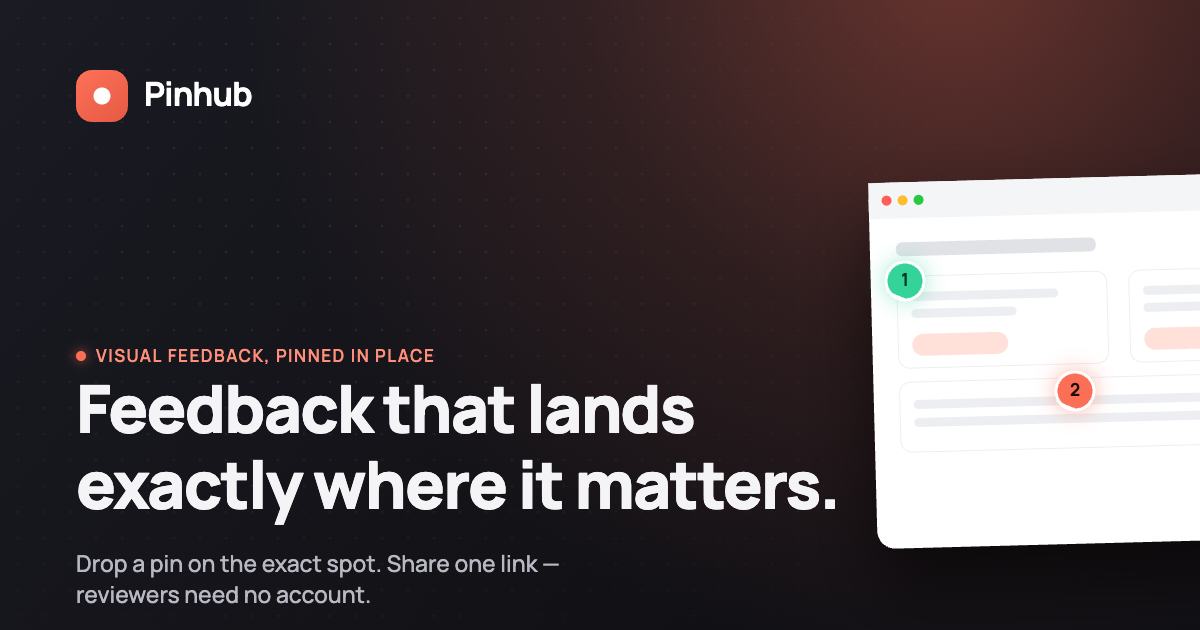
This fits naturally into the rollout checklist above. Run your pilot with Pinhub's version history and pixel-anchored comments in place, and you'll have an audit trail from first draft to approved version without extra spreadsheets. Plans range from a free tier for light use to Pro and Team paid plans, both also available annually. Check the Pinhub plans and features to see which fits your team's rollout.
Where to go deeper on setup and workflow design
For hands-on setup, Git LFS documentation and the Pro Git branching guide cover the technical details. CadShift's CAD version control guide is worth bookmarking for reference management. Our own guides on Figma versioning and remote design reviews offer more prescriptive templates.
Sources
- Git LFS documentation — GitLab
- Git - Branching Workflows (Pro Git book)
- CAD file version control best practices — CadShift
FAQ
What are the three types of version control?
The three common types are local version control, centralized version control, and distributed version control. Local systems track changes on one machine, centralized systems like Perforce or PDM tools store the master copy on a server, and distributed systems like Git give every user a full copy of the project history.
What is the difference between SCM and VCS?
Version control system (VCS) refers specifically to tools that track file changes over time, such as Git or Perforce. Software configuration management (SCM) is a broader practice that includes version control along with build management, release tracking, and change control across a whole project.
How can I create my own version control system?
Building a custom version control system generally means defining how changes are recorded, deciding whether files get locked or merged, and building storage that keeps a full history of each version. For nearly all teams, adopting an existing system like Git with Git LFS or a PDM tool is far more practical than building one from scratch.
What are the top tools for design versioning?
Common choices include Git paired with Git LFS for token and code-adjacent assets, Figma's native branching for UI work, and PDM systems like SolidWorks PDM or Autodesk Vault for CAD-heavy engineering files. The right choice depends on whether your files can be merged or need strict locking, as covered in CadShift's CAD guide.
Does Pinhub include version control features?
Pinhub includes version history as part of its Pro and Team plans, letting teams track changes alongside pixel-anchored feedback on the same file. Current pricing details are available on the Pinhub plans page.