
Anonymous feedback works best for candid preference checks and sensitive stakeholder opinions, not for bug reports or follow-up conversations. Resources like the Typeform design feedback template and guidance from NN/g back this distinction between candor and traceability. Start with a short, structured anonymous form, built on rating scales plus one targeted open-text question, shared through a single guest link.
TL;DR:
- Use identified or pseudonymous feedback for bug reports, clarification, role-based analysis, or prize drawings, because anonymity removes context and contact options.
- Match questions to review stage: ask about layout and flow for wireframes, hierarchy and tone for visual designs, and approval blockers before launch.
- Remove direct identifiers, tracking links, and file metadata; broaden team labels, redact identifying details in comments, and suppress tiny segments vulnerable to elimination.
- Group comments by theme, compare rating scores, and require repeated independent mentions before major changes; seek expert review for high stakes launches or conflicting signals.
Table of Contents
- When to use anonymous feedback and when to require identity
- How to design anonymous feedback forms and prompts
- Choose anonymity level and prevent re-identification: a privacy checklist
- Distribution and tooling: share links, unmoderated testing, and guest/no-login review flows
- Synthesize anonymous feedback into decisions and tasks
- When to hire an independent expert review instead of relying on anonymous input
- How we approach anonymous reviews at Pinhub
- Try a faster guest review workflow
- FAQ
- Sources
- Authoritative guides and templates to implement anonymous feedback
When to use anonymous feedback and when to require identity
The decision comes down to what you need more: candor or context. Anonymity removes hierarchy pressure and lets reviewers say what they actually think, but it also removes your ability to follow up, reproduce a bug, or segment responses by role.
Anonymous collection fits these situations well:
- Early preference testing between design directions, where you want gut reactions instead of justified opinions.
- Candid stakeholder rounds, especially when junior team members or clients might hold back if their names were attached.
- Sensitive-topic feedback, such as opinions on a rebrand or a change that affects someone's existing work.
Identity or pseudonymity works better here:
- Bug reports and usability issues that need reproduction steps or screen recordings.
- Any feedback that requires a follow-up question to clarify what the reviewer meant.
- Segmented analysis, where you need to know if the confusion came from new users or power users.
- Feedback tied to a reward, credit, or prize drawing, since you need a way to contact the winner.
Before choosing a channel, consider these questions: Will I need to ask a follow-up question? Will I need to trace this comment back to a specific user segment or role? Does the topic involve a power dynamic that might suppress honest answers if names are visible? If you need follow-up or segmentation, identified or pseudonymous feedback may be a better fit. If a power dynamic might suppress honest answers and you do not need follow-up or segmentation, anonymity may be preferable.
How to design anonymous feedback forms and prompts
"What do you think?" produces vague, low-value answers because it gives reviewers no frame for their response. Specific prompts, the kind recommended in the Typeform design feedback template, ask reviewers to evaluate one thing at a time: whether the purpose of a screen is clear, what feels confusing or out of place, which of two options they prefer and why, and what single change would improve the design most.
Build your form around a small set of question types rather than one open box:
- Clarity rating. A 1 to 5 scale asking how clear the purpose of the screen is.
- Confusion flag. A short open-text field asking what felt confusing or out of place.
- Preference with reason. A single-choice question between design options, paired with a required "why" field.
- Location anchor. A question asking which part of the page or screen the comment applies to, so you know exactly where the feedback points.
- One-change prompt. A focused question: "What one change would improve this the most?"
Separate your question sets by stage. A wireframe review should ask about layout and flow, not color or typography. A visual-design review should ask about hierarchy, contrast, and tone. A pre-launch review should ask approval-style questions: does this match the brief, and is there anything that would block sign-off? Mixing these stages into one generic form produces scattered answers that are hard to act on.
Pilot the form before sending it widely. A pilot catches confusing wording, missing context, or a question that everyone skips, the same reason NN/g recommends piloting unmoderated test tasks before launch.
Pro Tip: Keep the form concise. A concise form can make it easier for reviewers to complete it.
Choose anonymity level and prevent re-identification: a privacy checklist
Anonymous only means anonymous when the data behind it can't be traced back to a person. A guide on preventing re-identification lays out three working levels: fully anonymous, where no identifying data is collected at all; pseudonymous, where responses carry a stable but disconnected label, useful if you need to follow up without knowing who someone is; and identifiable, where names and roles are visible. Each fits a different need, and the "full-anonymity paradox" is real: the more anonymous a channel is, the less you can contextualize or follow up on what you learn.
Five operational steps keep anonymity real instead of cosmetic, based on the same re-identification guidance:
- Remove direct identifiers like name, email, and employee ID from the form itself.
- Avoid URL parameters or tracking links that quietly tie a response back to a specific recipient.
- Coarsen attributes such as job title or team into broader categories instead of exact labels.
- Redact or strip proper nouns from free-text answers before sharing results, since a comment that names a specific person or project can re-identify a reviewer.
- Withhold small-sample cross-tab cells. A segment with very few respondents can be re-identified by elimination even without a name attached, which is the core idea behind k-anonymity safeguards.
IP addresses, timestamps, and file metadata deserve the same attention. A form tool that logs IP by default, or a shared file whose metadata lists the last editor, can undo every other precaution. Check your form settings before you send the link, and strip metadata from any files you share back to the team.
Distribution and tooling: share links, unmoderated testing, and guest/no-login review flows
Three collection methods cover most anonymous design feedback needs, and each has its own setup.
A shareable anonymous link is the simplest option. Create one link, turn off any required identity fields, and add a one-line privacy note explaining what you log, such as "we don't collect names or emails with this form." Send the same link to everyone rather than generating individual ones, since individual links can be traced back to a recipient.

Unmoderated testing fits when you want independent reactions without a moderator's influence, but it requires more explicit instructions than a moderated session, since participants can't ask clarifying questions. NN/g's guidance on unmoderated testing recommends stating the scenario, the exact task, and the success condition up front, and piloting the test before launch to catch wording or flow problems.
Guest or no-login reviewer flows work well for stakeholders who won't create an account just to leave a comment. When setting one up:
- Confirm the guest link only exposes the review surface, not your admin or project settings.
- Password-protect links shared outside your immediate team.
- Separate the management link, which you keep, from the guest link, which you distribute.
- Decide in advance whether guest comments will display a generic reviewer label or remain unlabeled.
A tool like Pinhub supports this last flow directly: guest reviewers pin comments to specific points on a screenshot without creating an account, which keeps the anonymous channel open while still anchoring feedback to an exact location on the design.
Synthesize anonymous feedback into decisions and tasks
Raw anonymous responses are not a decision. Turning them into one takes a short, repeatable workflow.
- Aggregate the ratings first. Pull every 1 to 5 score into one view and flag components that score lowest across reviewers.
- Cluster open-text comments by theme. Group similar remarks together rather than reading each one in isolation.
- Set a corroboration threshold. Look for repeated independent mentions before making a major change based on anonymous input alone. A single comment might reflect personal taste rather than a real usability problem.
- Map each theme to severity and priority. Sort findings into triage buckets, blocking, important, or minor, and assign an owner to each.
- Open a pseudonymous follow-up channel when you need context. If a theme is unclear, a pseudonymous thread lets you ask a clarifying question without fully revealing who raised it.
This structure matches what NN/g recommends for any feedback synthesis: a clear review goal, comments tied to user needs rather than personal preference, and repeated themes identified before anything changes in the design.
Pro Tip: Log every theme you decide not to act on, along with why. A one-off comment that gets revisited later is easier to evaluate when you can see it was already considered.
When to hire an independent expert review instead of relying on anonymous input
Anonymous feedback tells you what people think. It doesn't tell you why a pattern violates a usability principle or how severe the risk really is. High-stakes launches, major strategy shifts, or anonymous signals that contradict each other are the clearest signs that a different approach is needed.
An independent expert review grounded in usability research delivers something anonymous feedback can't: principle-based findings, a severity rating for each issue, and recommendations ranked by priority rather than by who spoke loudest. When you commission one, ask for a written report that names the heuristic violated, rates severity, and lists a prioritized next step for each finding, not just a list of impressions.
How we approach anonymous reviews at Pinhub
We rely on guest links and pixel-anchored comments to collect input that stays tied to an exact spot on a design. We roll findings into a short action list.
— Pinhub
Try a faster guest review workflow
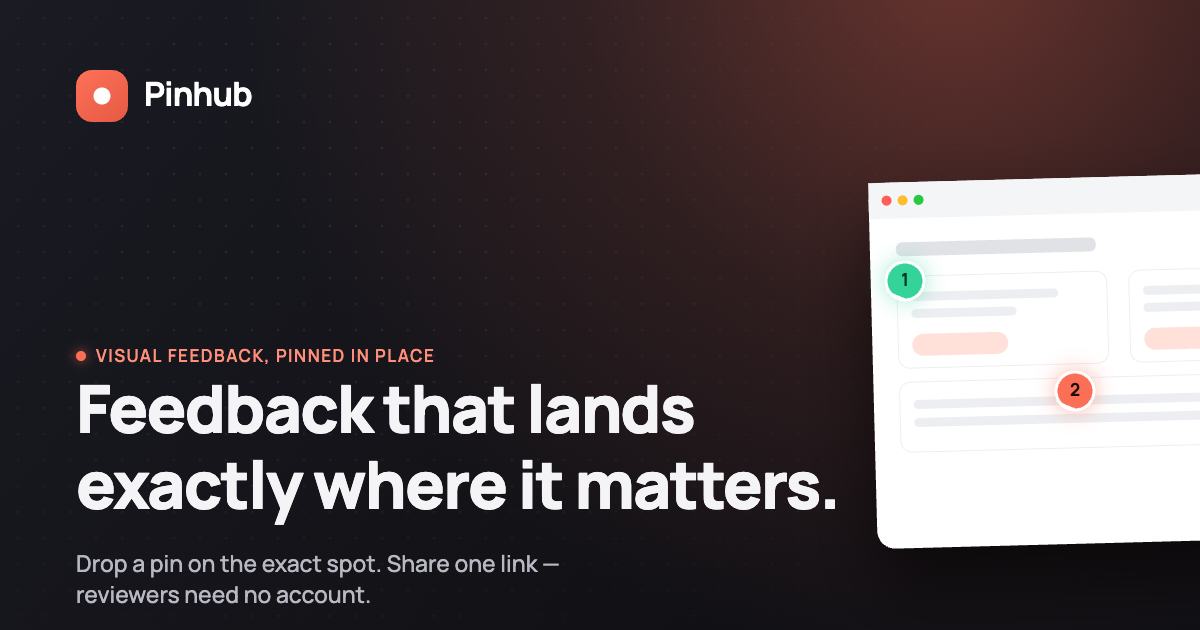
Collecting anonymous feedback shouldn't mean choosing between candor and clarity. We built Pinhub so guest reviewers can pin comments directly to the part of a screenshot or Figma file they're reacting to, no account required.
A few features make anonymous rounds easier to run:
- Pixel-anchored pins that tie every comment to an exact location, so vague feedback becomes specific.
- Guest and no-login links for reviewers who shouldn't need an account.
- Password protection for links you share outside your core team.
- Summaries that pull scattered comments into a short, readable list.
Create a one-page review, share the guest link with reviewers, and see how quickly the comments turn into a punch list. Our free plan is a good place to start.
FAQ
How can I give anonymous feedback on a design?
Use a shareable form or guest link that doesn't require a name, email, or login, and fill in specific prompts like clarity ratings, confusion flags, and a location anchor rather than one open question. A short, structured form with targeted questions produces more usable answers than a blank comment box.
Are anonymous complaints and reviews really anonymous?
Only if identifiers, tracking links, and small-sample segments are handled carefully, as explained in the risks highlighted in Why Avoid Anonymous Reviews: Risks for Your Brand. Removing a name from a form isn't enough; attributes need coarsening and free text needs checking for proper nouns, following the re-identification safeguards that prevent a response from being traced back through elimination.
When should I skip anonymous feedback and get an expert review instead?
High-stakes launches, major strategy changes, or anonymous signals that contradict each other call for an independent expert review grounded in usability principles rather than opinion alone. An expert review adds severity ratings and prioritized recommendations that anonymous comments can't provide on their own.
What should I check before choosing an anonymous feedback tool?
Confirm the tool doesn't log identifying data like IP addresses or tracking parameters by default, and that guest links expose only the review surface, not admin settings. Platforms built for guest review without login make this easier to set up correctly from the start.
How do I write questions that get useful anonymous answers?
Ask about one specific thing at a time, such as whether the purpose of a screen is clear, what feels confusing, or which of two options the reviewer prefers and why. Separate your questions by stage, wireframe, visual design, or pre-launch, since a structured feedback form with distinct question sets surfaces clearer patterns than a single generic form.
Sources
Authoritative guides and templates to implement anonymous feedback
Start with the design feedback template and guest review setup for ready-to-use forms and no-login flows.