
Stakeholder feedback management is the repeatable process of collecting, analyzing, and acting on stakeholder input so projects and decisions improve. The most practical framework for it is A.C.A.F.: Ask, Categorize, Act, Follow-up, a four-step lifecycle that turns raw opinions into visible outcomes. Before you read further, here are three things you can do this week:
- Who to ask: List your top five stakeholders by influence and schedule one touchpoint with each.
- Cadence to start: Set a recurring weekly 30-minute synthesis meeting to review new input.
- Named owner: Assign one person to triage every piece of incoming feedback and route it to the right decision-maker.
Key Takeaways
Effective stakeholder feedback management requires a named owner, a repeatable A.C.A.F. cycle, and a close-the-loop habit, not just a survey tool.
| Point | Details |
|---|---|
| A.C.A.F. is the core framework | Ask, Categorize, Act, Follow-up turns raw input into decisions and prevents feedback decay. |
| Close-the-loop rate matters most | Tracking whether stakeholders heard back predicts future participation better than response volume. |
| Map before you ask | Use a power/interest matrix to identify who to engage and at what depth before sending any survey. |
| Purpose drives method selection | Choose your collection method based on what you need to learn first, then filter by budget and time. |
| Usepinhub for visual feedback | Pixel-anchored comments, guest reviewer access, and AI summaries speed the A.C.A.F. loop for design and product teams. |
Table of Contents
- Why stakeholder feedback management drives better project outcomes
- How internal and external stakeholder feedback differ
- Common pitfalls in a stakeholder feedback program and how to avoid them
- How to collect stakeholder feedback: methods, when to use each, and sample questions
- How to organize, analyze, and prioritize feedback with the A.C.A.F. framework
- How to close the loop and govern feedback so it shapes decisions
- How to map stakeholders so you ask the right people
- Templates and checklists you can copy right now
- What actually separates feedback programs that work from those that stall
- Usepinhub makes the A.C.A.F. loop faster for design and product teams
- Sources
- FAQ
Why stakeholder feedback management drives better project outcomes
Stakeholder feedback is the structured input you collect from anyone with a stake in your project or organization, then use to guide decisions. Done well, it connects three things that most projects struggle to align: what stakeholders expect, what teams deliver, and what decisions get made.
Four reasons it belongs in your process:
- Better decisions: Feedback surfaces blind spots before they become costly change.
- Risk reduction: Early input from affected groups catches scope, compliance, or adoption risks while they are still cheap to fix.
- Stakeholder trust: People who see their input acknowledged stay engaged. Those who feel ignored disengage or escalate.
- Accountability: A documented feedback trail shows regulators, executives, and auditors that decisions were informed.
The IAP2 engagement spectrum frames participation across five levels: inform, consult, involve, collaborate, and empower. Most projects operate at "consult" by default, but the framework reminds you to be explicit about which level you are offering and to follow through on what you promised.
The most common failure is not poor collection. It is collecting feedback and never closing the loop. According to Perspective AI's feedback lifecycle guide, program health is best measured by response rate, time-to-insight, and close-the-loop rate, not by the volume of responses you gather.
How internal and external stakeholder feedback differ
The biggest practical difference is speed and stakes. Internal stakeholders (team members, department heads, executives) expect fast, operational responses. External stakeholders (clients, regulators, community groups, end users) expect strategic acknowledgment and formal follow-through.
Internal feedback:
- Channels: Slack threads, sprint retrospectives, internal surveys, one-on-ones, project management tool comments
- Cadence: Weekly or per-sprint
- Typical owner: Team lead or project manager
- Tone: Direct, solution-focused
External feedback:
- Channels: Client workshops, satisfaction surveys, in-product prompts, support logs, public consultations
- Cadence: Monthly, quarterly, or milestone-based
- Typical owner: Account manager, engagement lead, or communications team
- Tone: Formal, transparent, with documented follow-up
The IFC Stakeholder Engagement guidance recommends planning disclosure, consultation, and grievance management as distinct components, each with its own responsibilities and timetable. That structure applies directly to external programs. For internal programs, a lighter governance model works, but the principle of assigning clear ownership still holds.
One practical rule: match your channel to your stakeholder's availability. A regulatory body will not respond to an in-product prompt. A remote design team will not attend a formal public consultation.
Common pitfalls in a stakeholder feedback program and how to avoid them
The most damaging failure mode is collecting feedback without acting on it. Stakeholders who submit input and hear nothing back stop participating, and rebuilding that trust takes far longer than the original engagement would have.
Here are the most common problems and their mitigations:
- Survey fatigue: Sending too many surveys too often. Mitigate by limiting active surveys to one per stakeholder group at a time and rotating topics quarterly.
- Inbox chaos: Feedback arriving through too many channels with no routing logic. Mitigate by designating one intake channel per stakeholder type and using a shared triage inbox or tool.
- No named owner: Feedback sits unread because everyone assumes someone else will act. Mitigate by assigning a single triage owner per program and publishing that name internally.
- Contradictory input: Two stakeholder groups want opposite things. Mitigate by segmenting feedback by group before synthesis, then escalating conflicts to the decision-maker with both positions documented.
- Low response rates: Outreach goes unanswered. Mitigate by personalizing invitations, keeping surveys under five minutes, and sending one reminder with a clear deadline.
Pro Tip: Write your "you said, we did" close-the-loop message before you launch the survey. Knowing what you will communicate back forces you to ask only questions you can actually act on, which keeps the survey short and the follow-up credible.
How to collect stakeholder feedback: methods, when to use each, and sample questions
Purpose-first method selection consistently produces better method fit than choosing by convenience. Start by asking what you need to learn, then filter by budget, time, and stakeholder availability. Pairing a continuous passive floor (support tickets, in-product prompts, review logs) with a recurring active probe (quarterly survey, annual interview) gives you both breadth and depth.

| Method | When it fits best |
|---|---|
| Online survey | Large groups, quantitative benchmarks, low budget, asynchronous |
| Semi-structured interview | Deep qualitative insight, senior stakeholders, small sample |
| Focus group | Exploring reactions, testing concepts, small group of participants |
| Workshop | Co-creation, prioritization, cross-functional alignment |
| In-product prompt | Real-time feedback at the moment of use, digital products |
| Support log review | Passive signal, high volume, identifies recurring pain points |
| Conversational AI interview | Scaling qualitative depth, async, global teams |
| Social/listening tools | External sentiment, unfiltered opinion, brand or policy topics |
Sample questions to adapt:
- "On a scale of 1–10, how well does this project meet your expectations so far?"
- "What one change would have the most positive impact on your experience?"
- "Which part of the process created the most friction for you?"
- "What information do you wish you had received earlier?"
- "How confident are you that your input has influenced the project direction?"
- "What would make you more likely to participate in future feedback sessions?"
Best practices for response rates:
- Keep surveys to five questions or fewer for a first round.
- Send invitations from a named person, not a generic address.
- Explain in two sentences what you will do with the responses.
- Set a specific deadline rather than an open-ended window.
- Follow up once, at the midpoint of the collection window.
For guidance on designing effective survey questions, structure each question around a single, answerable idea and avoid leading phrasing that nudges respondents toward a preferred answer.
How to organize, analyze, and prioritize feedback with the A.C.A.F. framework
Categorize before you share. Raw feedback handed directly to a decision-maker without tagging or synthesis creates noise, not clarity. The A.C.A.F. loop gives you a repeatable structure to move from raw input to prioritized work items.
A.C.A.F. checklist:
Ask
- Define the question or decision the feedback will inform.
- Choose the method and recruit participants (see Section 5).
- Set a collection window with a hard close date.
Categorize
- Tag each item by theme (e.g., usability, timeline, communication), touchpoint, and severity (critical / moderate / minor).
- Group duplicates and near-duplicates into single themes.
- Use a shared spreadsheet, tagging tool, or feedback platform to make tags visible to the whole team.
Act
- Run an impact × effort prioritization pass: high-impact, low-effort items go first.
- Assign each prioritized item an owner and a due date.
- Route items to the right team: product, communications, operations, or leadership.
Follow-up
- Send a "you said, we did" update to every stakeholder who contributed.
- Mark items as resolved in your tracker and note the outcome.
- Archive unactioned items with a reason so they are not lost.
Metrics to track:
- Response rate: (Responses received ÷ Invitations sent) × 100. Target varies by method; A reasonable floor for survey response rates is often recommended.
- Time-to-insight: Days from collection close to synthesis report delivered. Shorter is better; set a team SLA and track it each cycle.
- Close-the-loop rate: (Items with a documented follow-up ÷ Total items actioned) × 100. This is the metric most programs neglect, and it predicts future participation better than any other.
How to close the loop and govern feedback so it shapes decisions
Closing the loop is not optional. Stakeholders who receive a "you said, we did" update are far more likely to participate in the next round than those who hear nothing. The UN SDG stakeholder engagement guide stresses that transparency about what can change, and what cannot, is what keeps engagement credible over time.
Governance roles:
- Triage owner: Reviews all incoming feedback within 48 hours and tags it.
- Synthesizer: Runs the weekly synthesis meeting and produces the summary report.
- Communications lead: Drafts and sends close-the-loop messages to stakeholders.
- Decision-maker: Reviews prioritized items monthly and approves or defers actions.
Cadence and outputs:
| Frequency | Meeting/Activity | Output |
|---|---|---|
| Daily | Triage inbox review | Tagged and routed items |
| Weekly | Synthesis meeting | Prioritized shortlist, owner assignments |
| Monthly | Decision review | Approved actions, deferred items with reasons |
| Quarterly | Trend analysis | Pattern report, program health metrics |
"You said, we did" message template:
Keep it short, specific, and tied to what stakeholders actually said. A generic "thank you for your feedback" with no specifics does more harm than no message at all.
How to map stakeholders so you ask the right people
Map first, ask later. Sending feedback requests to the wrong people wastes their time and yours, and it can produce misleading data that drives bad decisions.
The power/interest matrix is the most practical starting point. Plot each stakeholder on two axes: their level of influence over the project and their level of interest in its outcomes. High power, high interest stakeholders need direct engagement. High power, low interest stakeholders need regular briefings. Low power, high interest stakeholders are often your most detailed respondents and should not be overlooked.
Selection rules:
- Include at least one representative from each affected group, not just the loudest voices.
- Protect vulnerable or marginalized groups by offering anonymous response options and accessible formats.
- Include domain experts who can validate technical assumptions, even if they have low organizational power.
- Recruit influencers within each group: the person others listen to often shapes how the group responds collectively.
- For external programs, the IFC guidance recommends documenting your identification methodology so it can be audited.
For most project-level programs, a small sample of stakeholders per group is enough for qualitative synthesis. For quantitative surveys, aim for statistical adequacy relative to the population size, and consider stratified sampling to avoid over-representing any single subgroup.
Templates and checklists you can copy right now
Stakeholder survey template (5 questions):
- How well is this project meeting your expectations? (1–10 scale)
- What is working well that we should protect?
- What one thing would you change if you could?
- How clearly have we communicated project updates to you? (1–10 scale)
- Is there anything else you want us to know before the next milestone?
Outreach email template:
Subject: Your input on [Project Name] — 5 minutes
Hi [Name], we are gathering feedback on [Project Name] to improve [specific outcome]. Your perspective matters because [one sentence on their role or stake]. The survey takes under five minutes and closes on [date]. [Survey link] We will share what we heard and what we plan to do about it by [follow-up date].
First synthesis meeting checklist:
- All responses tagged by theme, touchpoint, and severity
- Duplicates merged into single themes
- Top three themes identified and documented
- Each theme assigned an owner
- Close-the-loop message drafted before the meeting ends
A.C.A.F. tracker columns:
| ID | Theme | Owner | Status | Close-the-loop note |
|---|---|---|---|---|
| — | Navigation confusion | UX lead | In progress | Notified stakeholders on [date] |
| — | Timeline clarity | PM | Resolved | Updated project calendar shared |
| — | Budget visibility | Finance | Deferred | Will revisit in Q3 review |
What actually separates feedback programs that work from those that stall
Most teams treat feedback as a data collection exercise. The programs that actually change outcomes treat it as a communication commitment. The difference shows up in one place: what happens after the survey closes.
The teams that improve fastest are not the ones with the most sophisticated collection tools. They are the ones who have a named person responsible for synthesis, a standing meeting to review it, and a habit of telling stakeholders what changed because of their input. That habit, more than any platform or methodology, is what keeps participation rates healthy over time.
One implementation detail that trips up otherwise well-designed programs: feedback routed to the wrong owner. A comment about visual clarity lands in the product backlog when it should go to the design lead. A concern about timeline lands with the communications team when it needs the project sponsor. The fix is a simple routing map, built once and reviewed quarterly, that matches feedback themes to the right decision-maker. Visual feedback tools that let you pin comments directly to a specific screen area, like Usepinhub's pixel-anchored approach, reduce this routing error significantly because the context travels with the comment.
Usepinhub makes the A.C.A.F. loop faster for design and product teams
Specialized feedback tools reduce the time between collecting input and acting on it, and they cut the translation errors that happen when a stakeholder's comment gets paraphrased through three people before reaching the person who can fix it.
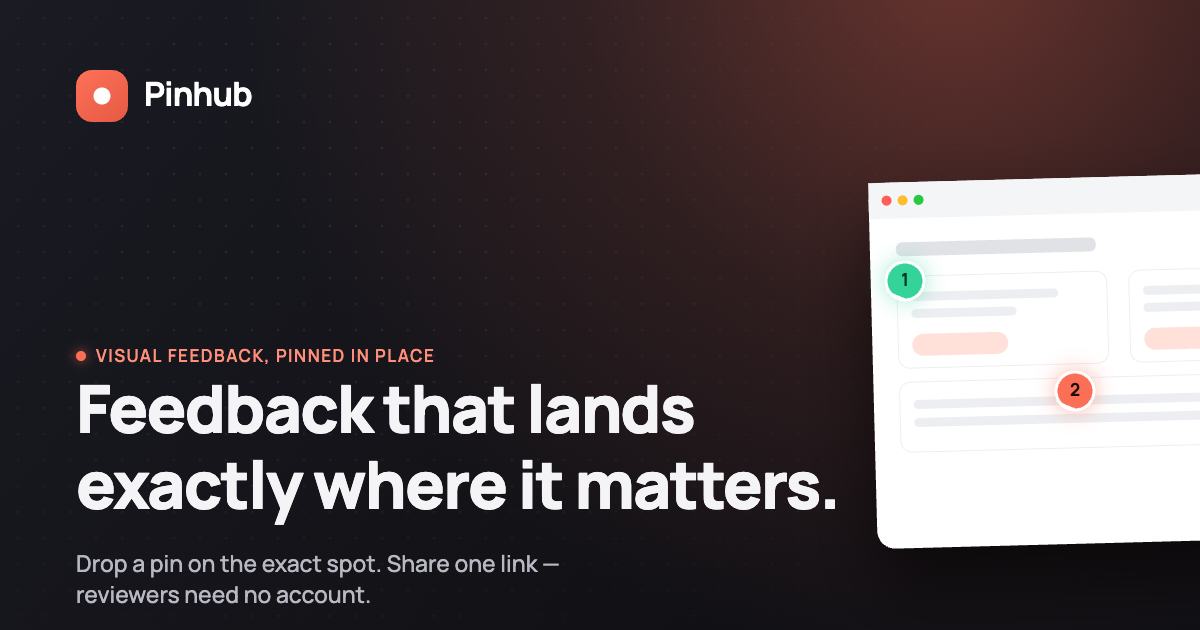
Usepinhub is built specifically for teams running visual feedback cycles. You upload a screenshot or Figma design, and stakeholders pin comments directly onto the exact pixel they are referring to. No account required for guest reviewers, so external stakeholders can participate without IT friction. Threaded discussions stay anchored to the screen location, AI-generated summaries surface the key themes without manual synthesis, and version control keeps every round of feedback tied to the right design iteration. For teams managing design feedback workflows, that combination shortens the Ask-to-Act cycle considerably. Start a free workspace at Usepinhub and run your first visual feedback round today.
Sources
- Customer Feedback Strategy: The Only Guide You'll Ever Need
- Customer Feedback in 2026: The Complete Guide to Collecting, Analyzing, and Acting On It | Blog | Perspective AI
- STAKEHOLDER ENGAGEMENT & THE 2030 AGENDA
- IFC stakeholder engagement guidance (Stakeholder Engagement)
- A stakeholder engagement method navigator webtool for clinical and translational science | Journal of Clinical and Translational Science | Cambridge Core
FAQ
What is stakeholder feedback management?
Stakeholder feedback management is the repeatable process of collecting, analyzing, and acting on input from anyone with a stake in a project or organization, then communicating what changed as a result. The A.C.A.F. framework (Ask, Categorize, Act, Follow-up) is the most widely referenced structure for running this cycle.
How do you manage stakeholder feedback effectively?
Assign a named triage owner, use a consistent tagging system to categorize input by theme and severity, prioritize by impact and effort, and always send a "you said, we did" update to close the loop. Tracking close-the-loop rate alongside response rate gives you a more accurate picture of program health than volume alone.
What are the 4 phases of stakeholder management?
The four phases most frameworks reference are: identify and map stakeholders, plan and disclose engagement, consult and collect input, and act and report back. The IFC Stakeholder Engagement guidance adds grievance management and monitoring as ongoing components that run across all phases.
What are the 4 C's of stakeholder management?
Definitions vary across frameworks, but a common version covers: Communication (keeping stakeholders informed), Consultation (seeking their input), Collaboration (working with them on decisions), and Commitment (following through on what you agreed to do). These align closely with the IAP2 engagement spectrum levels.
Which tools help teams manage visual stakeholder feedback?
For design and product teams, visual feedback platforms that let stakeholders pin comments directly onto screenshots or design files reduce miscommunication and speed the review cycle. Usepinhub supports pixel-anchored comments, guest reviewer access without account creation, AI-generated summaries, and version control, covering the full A.C.A.F. loop for visual assets.