
A sprint review is the end-of-sprint working session where the Scrum Team demonstrates the completed increment, gathers stakeholder feedback, and updates the product backlog. The goal is validation, not applause: you're checking whether the work actually solves the problem, and deciding what changes next. If you want one immediate improvement, start your next review with a strict 10-minute demo followed by a single feedback capture method, like pinned comments on a screenshot or one designated note-taker.
The measurable outcomes to watch:
- A validated (or rejected) increment, with reasons documented
- Updated backlog items reflecting new priorities
- Clear next steps everyone in the room agrees on
Pro Tip: Pick one feedback method before the meeting starts. Mixing sticky notes, chat messages, and verbal comments guarantees half of it gets lost by Tuesday.
Key Takeaways
Sprint reviews succeed when they produce a validated increment, updated backlog items, and decisions with named owners, not just a well-received demo.
| Point | Details |
|---|---|
| Define the review's purpose | Treat it as a working session to inspect the increment and adapt the backlog, not a presentation. |
| Separate review types | Name each design review as direction, craft, or decision so attendees bring the right feedback. |
| Prepare before the meeting | Send pre-reads, artifacts, and open questions ahead of time to avoid wasted live discussion. |
| Capture feedback with one method | Use pinned comments or a single note-taker, then convert notes into backlog items within 24 hours. |
| Use tools that anchor feedback | A platform like Usepinhub keeps comments attached to exact screen locations and versions, cutting down on ambiguous notes. |
Table of Contents
- Sprint Design Review Basics: Purpose, Timing, and Attendees
- Sprint Review vs Design Review: Clear Distinctions and When to Use Each
- Plan the Sprint Review: Copy-Ready Agenda and Pre-Reads
- Run the Review: Demo Techniques, Feedback Capture, and Decision Hygiene
- Fold Design Reviews Into Sprint Cadence: Sync vs Async Workflows
- Common Pitfalls, Metrics, and Experiments Worth Running
- Pinhub: A Practical Tool for Precise Feedback During Reviews
- Why Most Teams Get Sprint Reviews Half Right
- Get Sharper Feedback Without Chasing Screenshots and Comment Threads
- Sources
- FAQ
Sprint Design Review Basics: Purpose, Timing, and Attendees
The Scrum Guide treats the sprint review as one of four official events held at the end of every sprint to inspect the increment and adapt the product backlog. It's not optional, and it's not a status update dressed up as a meeting. It exists specifically to create a checkpoint where the team and stakeholders look at real, working output and decide together what happens next.
Timing scales with sprint length. Sprint review duration scales with sprint length; shorter sprints have shorter reviews, and the Scrum Guide sets a maximum duration proportional to sprint length as a guideline, rather than a fixed target.
Attendees include the Scrum Team, obviously, but also the people whose opinions actually change the backlog: product stakeholders, customers when relevant, and sometimes executives who fund the work. If nobody in the room can approve a backlog change or greenlight a direction, you're running a demo, not a review.
This is where the sprint review starts to differ from other agile design review moments:
- Sprint review: forward-looking, backlog-focused, stakeholder-inclusive
- Sprint retrospective: backward-looking, process-focused, team-only
- Informal demo: no agenda, no decisions, often just a status broadcast
Mountain Goat Software frames it well: a sprint review should be collaborative, not a one-way presentation where engineers click through screens while stakeholders nod.
Sprint Review vs Design Review: Clear Distinctions and When to Use Each
A design review is a tactical, narrower session focused on validating a specific design decision, whether that's a UI pattern, an architecture choice, or a flow before it ships. Unlike the sprint review, which happens once per sprint by rule, design reviews can happen one or two times per sprint, as needed, and they don't require the full stakeholder audience.
Storyflow's practitioner research recommends naming each design review by type, because vague invites produce vague feedback:
- Direction review: Are we solving the right problem, at a high level?
- Craft review: Does the execution meet quality and consistency standards?
- Decision review: Do we have enough information to commit and move forward?
Naming the review type up front tells attendees what kind of feedback to bring instead of forcing them to guess.
Who to invite depends on the type. Direction reviews need product and design leads. Craft reviews need peer designers and engineers who'll build it. Decision reviews need whoever holds the actual authority to say yes.
Pro Tip: If a design review keeps drifting into "wait, are we even solving the right problem?" mid-session, you scheduled a craft review when you needed a direction review. Reschedule instead of forcing it.
Plan the Sprint Review: Copy-Ready Agenda and Pre-Reads
A sprint review with no agenda turns into a rambling walkthrough nobody remembers by Friday. Here's a structure you can drop directly into a calendar invite for a one-hour session:
- Context (5 minutes): Sprint goal, what was planned vs. delivered
- Demo (20 to 25 minutes): Live or recorded walkthrough of the working increment, organized by acceptance criteria, not by ticket number
- Q&A and feedback (15 to 20 minutes): Structured discussion using your chosen capture method
- Backlog discussion (10 minutes): What shifts based on what was just shown
- Decisions and next steps (5 minutes): Explicit commitments, owners, and dates
Send these artifacts before the meeting, not during it:
- The sprint goal and a short list of what shipped
- Links to the actual working software, staging environment, or clickable prototype
- Any open questions the team wants stakeholder input on
- Relevant designs or screenshots, ideally with prior comment threads still attached so context isn't lost
Format pre-reads as a single page or link, not a scattered email thread. If stakeholders have to hunt for what they're reviewing, they'll skim instead of engaging.
Assign roles ahead of time. The Product Owner usually facilitates and owns the backlog conversation. Whoever built the feature demos it, since secondhand walkthroughs lose nuance. Someone, ideally not the facilitator, records decisions and owners in real time so nothing gets reconstructed from memory after the fact.

Run the Review: Demo Techniques, Feedback Capture, and Decision Hygiene
Frame every demo segment with the goal it's meant to satisfy before showing anything. "This feature lets returning customers reorder in one tap" gives stakeholders a lens to judge against; a cold screen share does not. Use live software whenever the environment is stable enough. Recorded walkthroughs work for complex setups or timezone-split teams, but they should never replace live Q&A entirely.
Feedback capture is where most reviews quietly fail. A few methods that hold up:
- Pinned comments: attach feedback directly to the screen or element it concerns, so "the button feels off" becomes "this button, this state, this reason"
- Asynchronous threads: useful when stakeholders span time zones and can't all join live
- A live note-taker: one person, not everyone, capturing feedback in a shared doc during the session
Whichever method you pick, the real work happens after: convert raw comments into backlog items before the meeting ends, or within 24 hours at the latest. Feedback that sits in a chat log for a week rarely makes it into a sprint.
Decision hygiene matters just as much as capture. Every decision made during the review needs three things logged: the decision itself, who owns the follow-up, and a target date. Skipping any one of those turns "we decided to simplify onboarding" into a debate you'll have again in three weeks.
Pro Tip: Assign a decision log template before the sprint starts, not during the meeting. Improvised note-taking under time pressure is how "owner: TBD" becomes a permanent backlog fixture.
Fold Design Reviews Into Sprint Cadence: Sync vs Async Workflows
Not every story needs a design review, and treating them all equally wastes everyone's time. During sprint planning, flag stories for design review only when requirements are ambiguous or the change touches multiple teams or surfaces. Routine, well-understood work should skip the ceremony entirely.
Here's a practical pattern for deciding sync versus async:
- Default to async for craft reviews: post the design with a pre-read, set a 48-hour feedback deadline, and let reviewers comment on their own schedule
- Escalate to a live session only for direction or decision reviews, where real-time back-and-forth actually resolves disagreement faster than a comment thread
- Attach feedback directly to the artifact, not a separate doc, so context and version history stay together as designs evolve
This async, pull-request-style pattern mirrors how engineering teams already review code, and Microsoft's engineering playbook notes it increases participation and gives reviewers more time to think through complex tradeoffs instead of reacting on the spot.
The tooling matters here. Feedback scattered across Slack, email, and screenshots pasted into docs loses its connection to the actual design the moment someone updates a file. A visual collaboration tool that keeps comments anchored to the specific screen and version avoids the "wait, which button are we talking about" problem that derails half of async reviews.

Common Pitfalls, Metrics, and Experiments Worth Running
The most frequent failure mode is mixing meeting types: a sprint review that turns into a craft critique, or a design review that spirals into a full backlog renegotiation. Teams often do this by accident, and it wastes time and demoralizes whoever prepared the wrong kind of material. A close second: no decisions recorded, so the same debate resurfaces next sprint. Defensive comments, where the presenter argues back instead of listening, kill honest feedback fast.
Three metrics worth tracking:
- Percentage of review feedback that becomes an actual backlog item
- Time elapsed from feedback given to decision made
- Stakeholder attendance and participation rate over time
Small experiments that move these numbers without a process overhaul:
- Silent reading: give attendees 3 to 5 minutes to read the pre-read before anyone talks
- Rotating facilitator: prevents one person's blind spots from shaping every review
- Pre-deadline async feedback: require comments 24 hours before a live session so the meeting starts with informed discussion, not first reactions
Pinhub: A Practical Tool for Precise Feedback During Reviews
Vague feedback is the single biggest tax on review quality, and it's usually a tooling problem, not a discipline problem. Pixel-anchored comments solve the ambiguity that plagues both sprint reviews and craft-type design reviews: instead of "the header looks off," a reviewer pins a comment to the exact pixel and states what's wrong. Guest reviewers can weigh in without creating an account, which matters when a stakeholder or client needs to comment once and never touches the tool again.
Two workflows worth borrowing:
- Pre-read plus pinned comments: share the screenshot before the sprint review, let stakeholders pin questions in advance, then spend live time resolving them instead of discovering them
- Async craft review to backlog: reviewers comment directly on the design, resolve threads as a checklist, and Usepinhub's automated summary lists turn open items into a ready-made backlog input
Version control keeps every prior round of feedback attached to its original screen, so nothing gets lost when a design updates.
Why Most Teams Get Sprint Reviews Half Right
The conventional advice on sprint reviews stops at "invite stakeholders and show your work," which misses the actual failure point: teams rarely lack a demo. They lack a mechanism for turning what's said in the room into something that survives past the meeting. The Scrum Guide is clear that the review exists to adapt the backlog, yet most teams treat backlog adaptation as an afterthought squeezed into the last five minutes.
The overlooked lever is naming your review types honestly. Teams that blend a craft critique into a sprint review, or let a design review devolve into a full requirements debate, aren't running one bad meeting. They're running the wrong meeting under the right label.
If you take one thing from this, take the discipline of separating detection from decision: figure out what kind of feedback you need before the invite goes out, not during the meeting. A tool that anchors comments to exact artifacts, like Usepinhub, makes that discipline easier to sustain because the feedback stays attached to what it's actually about.
— Pinhub
Get Sharper Feedback Without Chasing Screenshots and Comment Threads
Usepinhub replaces the scattered mix of screenshots, chat messages, and marked-up PDFs most teams rely on for design and sprint reviews. Every comment pins to an exact spot on the screen, so "fix the spacing" becomes a specific, unambiguous note tied to a version. Guest reviewers, including stakeholders and clients, can leave feedback without creating an account, which removes the biggest friction point in async craft reviews.
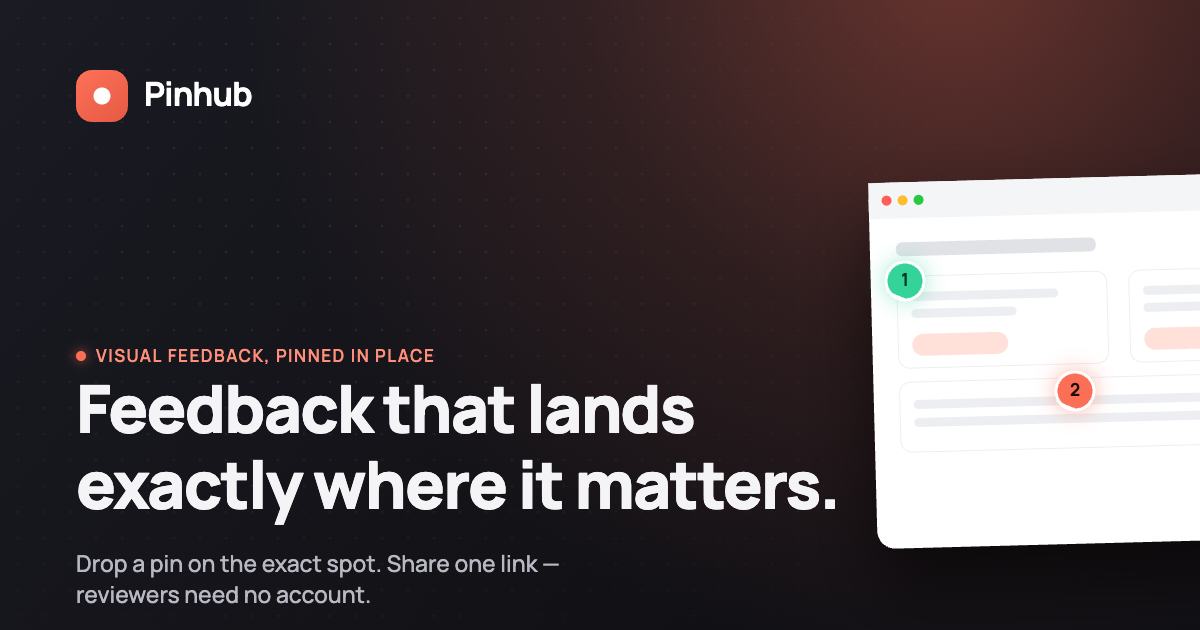
For teams running the pre-read plus pinned comments workflow described earlier, Pinhub's version history keeps every prior round of feedback attached to the right design, so nothing gets lost between sprints. Automated summary lists turn resolved threads into a checklist you can hand straight to the Product Owner for backlog grooming. If your next sprint review needs a faster way to capture and resolve feedback, start with Usepinhub and bring your first design into a review this week.
Sources
A few sources shaped the practices in this article, and each one is worth reading directly if you want the full rule set rather than a summary.
- The Scrum Guide — Scrum.org
- How to incorporate design reviews — Microsoft Code with Engineering Playbook
- How to run a design review (Storyflow)
- Sprint review meeting in Scrum — Mountain Goat Software
FAQ
What Is a Sprint Review Designed to Do?
A sprint review is designed to inspect the completed increment with stakeholders and adapt the product backlog based on what's learned, following the Scrum Guide's official rules for the event.
What Is the 3 5 3 Rule in Agile?
The 3 5 3 rule refers to Scrum's structure: 3 roles (Product Owner, Scrum Master, Developers), 5 events (Sprint, Sprint Planning, Daily Scrum, Sprint Review, Sprint Retrospective), and 3 artifacts (Product Backlog, Sprint Backlog, Increment).
Is Scrum Still Relevant in 2026?
Scrum remains widely used because its event structure, including the sprint review, gives teams a repeatable way to validate work and adjust priorities before too much effort goes into the wrong direction.
What Are the Five Steps of a Sprint Retrospective?
A typical sprint retrospective moves through five steps: set the stage, gather data, generate insights, decide what to do, and close the retrospective, distinct from the sprint review's focus on the product itself.
How Is a Design Review Different From a Sprint Review?
A design review is a tactical session focused on a specific design decision and can happen multiple times per sprint, while a sprint review is a single, mandatory event reviewing the full increment with stakeholders.