
A good UX design critique is formative feedback aimed at improving work in progress, not a vote on whether to approve it. The process that makes this work has four phases: the presenter states goals and constraints, the group holds a focused discussion, someone captures decisions, and the team defines next steps. Send context 24 hours ahead and assign a facilitator, and feedback gets specific instead of vague.
TL;DR:
- Clear purpose is essential to prevent mismatched expectations and ensure critique sessions are focused on specific goals like unblocking decisions or checking consistency.
- Distinguishing critique from review avoids treating critiques as approvals and keeps feedback constructive for ongoing work rather than final decisions.
- Sharing context 24 hours ahead and following a structured agenda significantly improves the quality and actionability of feedback within a typical 30-minute session.
- Using different critique methods suited to each stage—such as silent, pair, or dot voting—maximizes insight and minimizes noise, especially in remote or distributed teams.
- Effective critique programs rely on consistent practices, trained facilitation, and tools like pixel-anchored comments to sustain progress and embed feedback as a collaborative problem-solving process.
Table of Contents
- Why UX Design Critique Sessions Need a Clear Purpose
- Critique vs Review: A Short Ruleset Teams Must Adopt
- Preparing for a Critique: The 24-Hour Rule and a Ready Agenda
- Six Critique Methods and When to Use Each
- Common Critique Pitfalls and How Facilitators Fix Them
- Capturing Decisions and Prioritizing What Actually Gets Built
- Running Fair, Fast Critiques With Remote and Async Teams
- How Pinhub Maps Best Practices Into an Actual Workflow
- What Actually Makes Critique Programs Stick
- Try Pinhub for Your Next Critique Session
- Sources
- FAQ
Why UX Design Critique Sessions Need a Clear Purpose
Most failed critiques trace back to one problem: nobody agreed on why the meeting existed. A session meant to unblock a stuck flow attracts different people, different questions, and a different tone than a session meant to check visual consistency across a product. When the purpose is fuzzy, participants show up with mismatched expectations, and the conversation drifts into whatever each person feels like talking about.
Before you send the invite, decide which job this critique is doing. That single choice shapes everything else, from who you invite to how long you book the room.
- Level up the craft. The goal is to sharpen visual or interaction quality on a specific screen or flow. Invite senior designers who can speak to detail and precedent.
- Unblock a problem. The team is stuck on a decision, and the goal is a path forward, not polish. Invite people close to the constraint (engineering, product, research) alongside design.
- Check consistency. The goal is alignment against a design system or existing patterns. Invite whoever owns the system plus anyone shipping in the same product area.
- Share context. The goal is simply to keep stakeholders informed before wider exposure. This one can run async more often than the others, since it needs awareness more than deep debate.
Confusing these purposes is how you end up with an unblock-a-problem session where three people spend ten minutes debating button color. The fix is naming the purpose out loud, in the invite, before anyone opens a file.
This distinction also determines when critique is the wrong tool entirely. If the actual need is a yes/no decision, a go/no go on shipping, or a check against a legal or brand requirement, that is an approval conversation, not a critique. Trying to squeeze approval into a critique format frustrates everyone. Designers feel judged instead of helped, and decision makers feel like the format is wasting their time on discussion when they just needed a sign off.
Critique vs Review: A Short Ruleset Teams Must Adopt
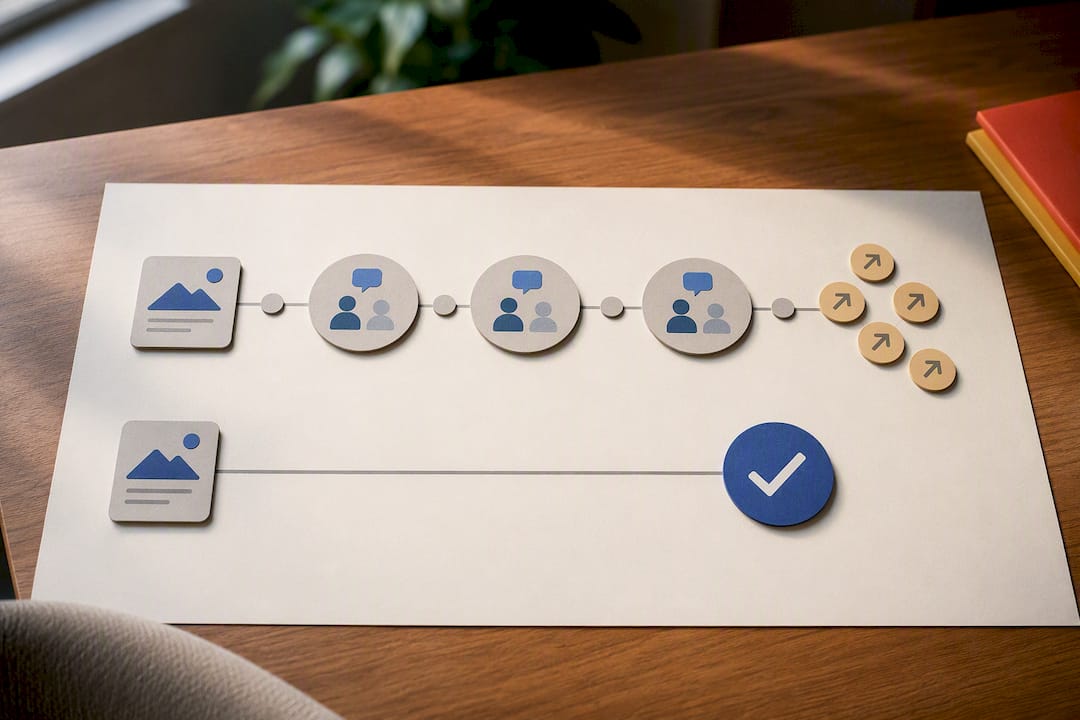
Teams that blur critique and review end up with the worst of both. Critique gets treated like a rubber stamp, and review gets bogged down in subjective taste debates that were never going to change the outcome. Separating them, as design teams that formalize the distinction have found, can cut meeting friction by roughly half.
The operational split is simple:
- Critique improves work that is not finished. The presenter wants input, expects to keep iterating, and the meeting has no approval authority attached to it.
- Review evaluates work against a decision point: ship or don't, meets the bar or doesn't. Reviewers hold real authority over the outcome.
Red flags that signal a team has the wrong meeting type include a presenter who gets defensive at every comment (a sign they walked into what they thought was a review), attendees asking "so are we approving this?" mid-critique, or a review meeting spiraling into fifteen minutes of color opinions with no decision made by the end. Our own breakdown of design critique versus review covers the operational differences in more depth if your team is drafting a policy.
The fix that works across both is mandatory: every session opens with the presenter stating the type of meeting, the goals, and the specific questions they want answered. Not "here's my screen." Instead: "This is a critique. I'm trying to solve the empty state problem on the dashboard. I want feedback on whether the illustration approach communicates the right tone." That thirty-second framing does more to focus a critique than any facilitation technique that comes after it.
Separation also changes what "actionable" means in practice. A critique comment like "have you considered a different layout here" is useful. The same comment in a review meeting, five minutes before a ship decision, is a liability, because now the team either ignores useful input under time pressure or delays a launch to explore an idea that was never fully formed.
Preparing for a Critique: The 24-Hour Rule and a Ready Agenda
The single highest-leverage habit in critique is also the easiest to skip: share context at least 24 hours before the meeting. Teams that adopt this window consistently report more actionable feedback, because reviewers arrive having already formed questions instead of reacting cold in the room.
What belongs in that 24-hour share:
- A one-paragraph brief describing what the work is trying to solve.
- The specific goals for this version (what changed since the last round, if any).
- Known constraints (technical limits, brand rules, accessibility requirements, timeline).
- Two or three target questions the presenter actually wants answered.
- Links to the design file, prototype, or screenshots, with clear entry points if there's more than one flow.
Skip the brief and you get generic reactions. Including it means reviewers show up ready to answer the actual question instead of inventing their own.
Group size matters almost as much as prework. Guidance from teams that have run critique programs at scale points to roughly 3 to 8 participants as the sweet spot. Below that, you lose diversity of perspective. Above it, the conversation slows to a crawl and quieter voices get crowded out.
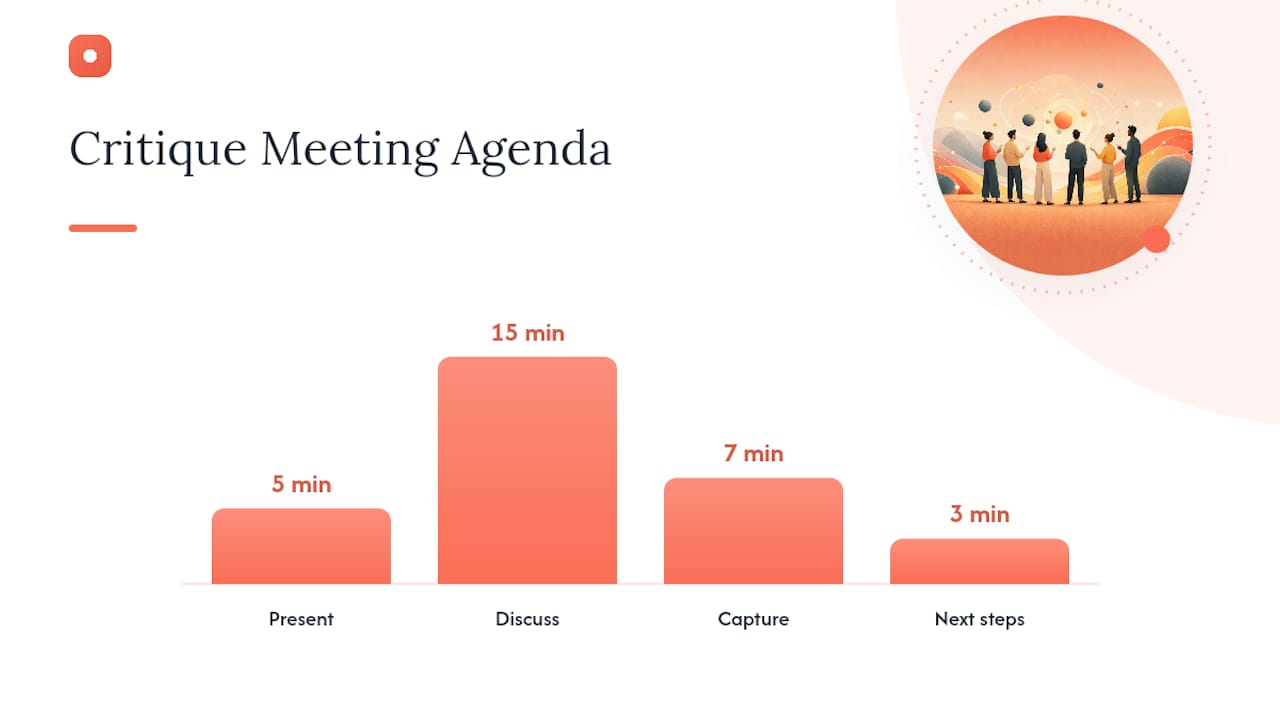
A reproducible agenda removes the guesswork of running the meeting live. Here's a 30-minute version built around the four-phase structure:
| Time | Phase | What happens |
|---|---|---|
| First 5 minutes | Present | Presenter states type, goals, constraints, and target questions |
| Next 15 minutes | Discuss | Group gives feedback tied to the stated questions; facilitator keeps discussion on track |
| Following 7 minutes | Capture | Recorder reads back key decisions and open items for confirmation |
| Final 3 minutes | Next steps | Presenter states what happens next and by when |
Three roles keep this agenda from collapsing into chaos. The presenter owns the framing and stays open, not defensive. The facilitator enforces the timebox, redirects solutionizing back to the stated goals, and makes sure quieter participants get a turn. The recorder writes down decisions and open questions in real time, separate from the general chat, so nothing depends on memory after the meeting ends.
Timeboxing each phase matters more than it sounds like it should. Without a hard stop on the discuss phase, critique sessions naturally expand to fill whatever time is available, usually by re-litigating the same two comments from three different angles.
Six Critique Methods and When to Use Each
No single format works for every stage of design. Figma's design team documents six methods they rotate between depending on the problem, and matching the method to the moment is what separates a critique that produces insight from one that produces noise.
Standard critique. The default format: presenter shares work, group discusses live, facilitator keeps time. Best for mid-stage work where the direction is set and the team needs alignment on execution. Run sheet: 5 minutes present, 15 minutes discuss, 5 minutes capture, 5 minutes next steps.
Silent critique. Reviewers write comments independently before anyone speaks out loud, often directly on the artifact. Best when you want equitable input from a group that includes junior designers or people who think slower than they talk. Run sheet: 10 minutes silent commenting, then 15 minutes discussing the written comments as a group, grouped by theme rather than by person.
Pair critique. Two people, usually the presenter and one senior reviewer, work through the problem together in real time. Best for deep, ownership-driven work where broad group input would slow things down rather than help. Run sheet: 20 to 30 minutes, informal, no recorder needed since decisions happen live.
Jam or workshop critique. The group doesn't just critique, it actively sketches alternatives together. Best for early-stage idea generation when the problem is still open and multiple directions are worth exploring. Run sheet: 10 minutes problem framing, 20 minutes parallel sketching, 15 minutes sharing and combining ideas.
Dot voting critique. After viewing multiple options or a set of comments, participants vote with a limited number of dots to surface priority. Best when there are more ideas or feedback items than time to discuss each one. Run sheet: 10 minutes viewing, 5 minutes voting, remaining time discussing only the top-voted items.
FYI or context-share critique. Low-stakes, informational, often async. Best for keeping stakeholders aware of direction before wider visibility, without demanding a live discussion slot. Run sheet: a written or recorded share with a 48-hour comment window, no live meeting required.
- Match jams to 0 to 1 exploration, standard critiques to mid-stage refinement, and silent or dot-voting formats to any session where a few loud voices tend to dominate.
- Combine methods for distributed teams: async silent comments first, then a shorter live session focused only on discussion and capture, since the presenting and reacting can happen on someone's own schedule.
Pro Tip: Rotate methods deliberately rather than defaulting to standard critique every time. A team that runs the same format for every stage of work usually has a facilitation problem disguised as a scheduling habit.
Common Critique Pitfalls and How Facilitators Fix Them
Five failure modes show up in almost every team that hasn't formalized its critique process, and each has a specific, learnable fix.
- Solutionizing. Reviewers jump straight to "you should try X" instead of naming the problem first. Fix: require feedback to state the observed issue before offering a fix, and have the facilitator redirect premature solutions back to "what's the problem you're seeing?"
- Bikeshedding. The group spends disproportionate time on a low-stakes detail (font size, icon choice) because it's easier to have an opinion about than the harder structural question. Fix: a facilitator-enforced quota, no more than two minutes on any single visual detail unless it ties directly to a stated goal.
- HiPPO (highest paid person's opinion). A senior voice states a preference, and the room defers instantly, killing further discussion. Fix: collect written or silent feedback before any live discussion begins, so junior voices commit their view before hierarchy has a chance to anchor the room.
- Vague feedback. Comments like "it doesn't feel right" or "I like it" carry no direction. Fix: require feedback to reference the stated goals or questions, and have the facilitator ask "can you say more about what specifically isn't working?" A stocked set of ready-to-use feedback phrasing helps reviewers practice specificity until it becomes habit.
- No follow-up. Decisions get made in the room and then evaporate the moment everyone opens Slack. Fix: the recorder role is non-negotiable, and captured decisions get sent out within the same day, not "sometime this week."
Psychological safety underlies all five fixes. A team that treats disagreement as productive, rather than personal, gets more honest input, and a facilitator who models curiosity ("tell me more") instead of judgment ("that's wrong") sets the tone for everyone else in the room.
Capturing Decisions and Prioritizing What Actually Gets Built
A critique that produces a great conversation and zero written record has produced nothing. The capture step needs a template, filled out live by the recorder, not reconstructed from memory afterward.
A workable template has five fields: decisions made, assumptions that got validated or invalidated, action items, who owns each one, and due date. Our design feedback template is built around this exact structure if your team wants a starting point rather than building one from scratch.
Not every comment deserves equal weight, and trying to implement every piece of feedback from a session is a fast way to produce a design shaped by whoever spoke loudest, most recently. Two prioritization patterns handle this cleanly.
The impact/effort matrix sorts action items into a quick two-by-two: high impact and low effort gets done immediately, high impact and high effort gets scheduled, low impact and low effort gets batched, and low impact with high effort gets dropped unless a stakeholder insists otherwise.
RICE (reach, impact, confidence, effort) works better when a team wants a numeric ranking across a longer backlog of feedback items rather than a single session's output. Score each factor, divide by effort, and the highest score wins the next sprint's attention.
Synthesis is where teams underinvest the most. Analysis of feedback workflows shows that the step from raw comments to prioritized action is consistently the weakest link, not the critique conversation itself. Look for patterns and frequency across comments rather than treating each one as an independent verdict. If three reviewers independently flag the same confusing interaction, that's signal. If one reviewer has a strong opinion nobody else shares, that's a data point worth noting, not a mandate.
Running Fair, Fast Critiques With Remote and Async Teams
Distributed teams lose two things by default: equal airtime and speed of synthesis. Fixing both takes deliberate structure, not just a video call replacing an in-person one.
Async-first critique starts with a recorded walkthrough instead of a live presentation. A short screen recording, the kind practitioner guides for remote critique recommend, lets the presenter explain goals and constraints once, on their own time, and lets reviewers watch it whenever fits their schedule instead of forcing a synchronous slot across time zones.
- Set a 48-hour comment window after the recording goes out, long enough for thoughtful input, short enough to keep momentum.
- Use a shared visual space where comments anchor to specific parts of the design rather than living in a separate chat thread disconnected from the actual screen.
- Structure written input into three buckets: what works, what doesn't, and open questions. This alone eliminates most vague feedback before it's even typed.
- Reserve the live meeting, if you hold one at all, for synthesis and decisions only. Nobody needs to watch a presentation together if they already watched it separately.
Synthesis is where async teams either win or lose the format. Centralizing comments on a shared canvas and running structured synthesis turns scattered input into clustered themes with frequency counts, which is exactly the pattern/frequency lens described in the prioritization section above. Whether that clustering happens manually by a designated synthesis owner or with AI-assisted tooling that groups similar comments automatically, the principle stays the same: someone needs explicit ownership of turning raw comments into a short, ranked list, or the async format just produces more unread feedback than a live meeting ever would.
How Pinhub Maps Best Practices Into an Actual Workflow
Every recommendation above assumes reviewers can point at exactly what they mean, and that assumption breaks down fast in a Slack thread full of "the button in the top area" style comments.
Pixel-anchored comments solve the ambiguity problem structurally. When feedback pins directly to the spot on a screenshot or Figma frame it refers to, there's no interpreting which "button" or which "top area" someone meant, which removes a whole category of the vague-feedback pitfall covered earlier.
- Guest reviewer access lets stakeholders, clients, or cross-functional partners comment without creating an account, which matters for the 24-hour context share since friction at the review step is exactly what causes people to skip prework.
- Automated summary lists give a recorder-style capture of comments without someone manually transcribing a live conversation.
- Version control keeps iterations traceable, so a critique's captured decisions stay tied to the exact version they were made against, not a later revision that quietly drifted from what was actually discussed.
The workflow doesn't replace facilitation or agenda discipline. It removes the friction that makes both harder to sustain.
What Actually Makes Critique Programs Stick
Most critique programs fail not because the format is wrong but because teams try to install the whole system at once and abandon it three weeks in when attendance drops. Start with one recurring session, one clear purpose, and one facilitator who commits to enforcing the timebox even when it feels awkward to cut someone off mid-sentence.
Measure the thing that actually matters: what percentage of captured action items get closed within two weeks.
Invest early in facilitator training, since the facilitator role is where most sessions succeed or collapse, and consider a light "critique of critiques" channel where the team occasionally reflects on what's working in the format itself. The biggest cultural shift is treating critique as collaborative problem-solving rather than a gate to get through, and that reframe has to come from leadership modeling it, not from a policy document nobody reads. Templates and mandatory session-type declarations do the rest, because structure removes the guesswork that makes critique feel risky in the first place.
— Pinhub
Try Pinhub for Your Next Critique Session
Pinhub is built for exactly the workflow this article describes: pixel-anchored comments that eliminate the "which button" ambiguity, guest access that removes friction from your 24-hour context share, and automated summaries that do the recorder's job for you.

If your team already runs standard or silent critiques but loses time chasing down what a comment actually refers to, that's the gap Pinhub closes. Upload a screenshot or connect a Figma file, pin comments to the exact spot they concern, and let stakeholders weigh in without setting up an account first. Version control keeps each critique's captured decisions tied to the round they were made against, so nothing drifts between sessions. Teams running frequent critiques can resolve comment threads as checklists, turning the capture step from this article into something closer to a running record than a one-off note.
Start on the free plan to try pixel-anchored feedback on your next session, or move to a Team plan when you need unlimited screenshots and Figma integration across the whole group.
Sources
A few sources go deeper than any single article can on specific pieces of this process.
- Design Critiques: Encourage a Positive Culture to Improve Products
- How we do design critiques at Figma | Figma Blog
- How to Run a Design Critique That People Don't Hate (2026 Guide)
- Feedback Loop Design: Run Reviews That Get Results | Miro
FAQ
What are the four types of critique?
Teams generally rotate between standard critique, silent critique, pair critique, and jam or workshop critique, with dot voting and FYI/context-share sessions as additional formats for specific situations. Each fits a different stage of work, from early idea generation (jams) to mid-stage alignment (standard critique).
Is UX design worth it as a career in 2026?
UX design remains a viable, in-demand discipline, and structured practices like disciplined critique programs are part of what separates strong teams from ones that ship inconsistent work. The field is evolving alongside AI tools, but the core skill of evaluating and improving user experience through structured feedback hasn't gone away.
Is AI replacing UX research?
AI tools are increasingly used to assist with synthesis, such as clustering feedback themes and surfacing frequency patterns, but they support the research and critique process rather than replace the judgment involved in framing problems and interpreting findings. Teams still need someone to own synthesis and make prioritization calls.
What are some red flags in a UX design job?
Watch for teams that conflate critique with approval (leaving designers unsure whether feedback is optional or mandatory), sessions with no facilitator or agenda, and a pattern of vague feedback with no follow-up on action items. A team that can't tell you how it prioritizes design feedback likely doesn't have a working critique process at all.
How long should a UX design critique session run?
Most standard critiques fit comfortably into 30 minutes using the present, discuss, capture, and next-steps structure. Timeboxing each phase matters more than the total length.